

How Automattic ships software from Slack with Indent
How Automattic's teams use Indent where work already starts: a Slack thread. One mention turns a bug report, alert, or product discussion into an investigation, a tested change, and a reviewed pull request.
- 95%
- of team-started sessions began in a messaging thread
- 937
- pull requests reviewed in 30 days
- 19
- repositories using Indent review
Automattic uses Indent where it's most natural: Slack. Every part of software work starts as a conversation: a customer reports a bug, an alert drops into an operations channel, a teammate asks a product question.
Mentioning @indent in the thread kicks off a new Indent session in an isolated cloud sandbox where the conversation context, Automattic's git repositories, a full running dev environment, and all the appropriate integrations are available. Indent can trace the problem, edit the code, run checks, and send a pull request back to the same thread.
Metrics cover the 30 days ending September 2, 2026.
About Automattic
Automattic builds products that span publishing, commerce, and communication. Its portfolio includes WordPress.com, WooCommerce, Tumblr, Beeper, and Spacefast, a research-preview product for publishing software and other work created by agents.
That range creates a broad surface for engineering work. Automattic's teams maintain web applications, mobile clients, APIs, infrastructure, and open-source systems. Bug reports and production alerts pass through the same Slack workspace as product discussions.
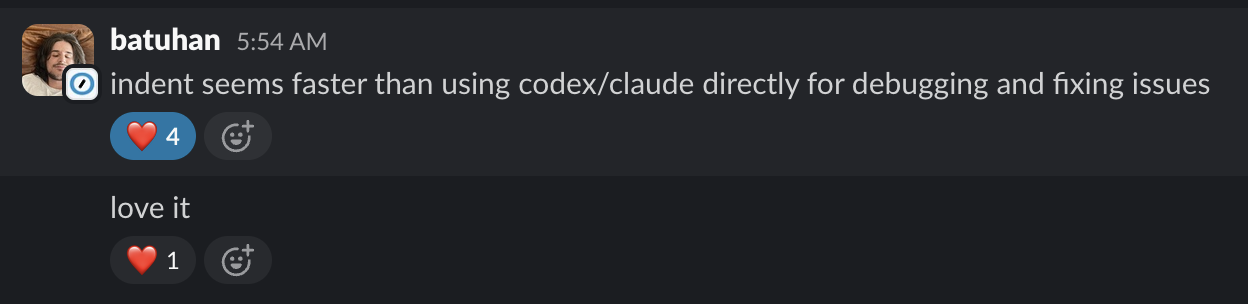
Batuhan İçöz began using Indent on one Automattic project and then introduced it to another. What started as a tool for one engineer became a shared way for Automattic teammates to investigate problems, write code, and review pull requests.
The shortest path from conversation to action
At Automattic, engineering work moves through channels for product development, infrastructure, support, and production alerts. A request might begin with a long incident thread. It might also begin with one line: "investigate," "fix it," or "find the exact reason this keeps happening and PR a fix."
Those short prompts work because the Slack thread is part of the input. In most of the Automattic Slack sessions we studied, Indent received earlier messages from the conversation with the request. "Investigate" already points to an alert, an error report, and whatever the team has tried.
The session can then move beyond Slack. Automattic has connected Indent to services including Railway for deployments and logs, PlanetScale for production data, Linear for issues, and Sentry for alerts. Indent can compare the conversation with the current state of those systems and the codebase.
The result is a useful change in how a team calls an agent. People do not have to collect the thread, open another application, paste the history, find the right repository, and explain the incident again. They start from the moment where a decision is needed.
What happens after "investigate"
Take a production alert. The Slack thread may already contain the endpoint, the time of the failure, a screenshot, and comments from the people who saw it. A teammate mentions Indent and asks it to investigate.
That mention creates a session with its own sandbox. Indent can read the relevant repository, inspect deployment logs, query production data through a read-only connection, and trace the failure into code. If the fix is clear, it edits the repository, runs the project's checks, and opens a pull request. Questions and results stay attached to the original thread.
The same path works for a feature request. A product discussion becomes implementation context. A teammate can answer a follow-up question in Slack, and Indent continues the existing session with the new constraint.
Automattic's usage shows how little ceremony this requires. Nearly every Slack session that produces a pull request starts from the thread where the work was initially discussed. Most generated a pull request after one or two instructions.
An agent the team can see
A private coding agent helps one engineer at a time. A Slack thread gives the rest of the team a window into the work. They can see the request, add context, answer questions, and open the resulting pull request without asking for a separate summary.
That visibility also makes adoption less formal. After Automattic connects Slack, its repositories, and the services the agent needs, a teammate can begin with a mention. One teammate started his first session about one minute after joining.
The Slack surface follows the team's existing privacy boundary. A mention in a shared channel creates a shared session. A direct message creates a private session for work that should stay between the requester and Indent.
The second pass starts automatically
Code generation is only half of the path to production. The change still needs a review that understands the surrounding code, catches behavior the diff makes easy to miss, and explains the fix on the affected line.
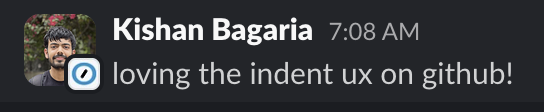
Indent runs that review automatically in GitHub. It reads each pull request in the context of the repository and posts findings on the relevant lines. Most findings include a concrete suggestion for fixing the issue. Later commits update the review as the code changes.
Automattic began with Indent review on a single repository. After seeing it in use, the team asked to expand review across the rest of the repositories for that project. Other Automattic projects now use the same review.
In the 30 days to September 2, Indent reviewed 937 pull requests across 19 Automattic repositories. Review is part of the normal development path, including code written by people and code written with agents.
Each finding points to behavior outside the happy path: a crash behind one interface, a permission leak across sites, or a secret exposed through a command argument. Indent gives every covered pull request the same codebase-aware pass.
Slack becomes a place where work finishes
Automattic did not create a separate process for AI work. The company added an agent to the conversations its teams already used to report bugs, discuss features, and respond to production.
A bug report can become an investigation. An alert can become a tested patch. A product thread can become a pull request. The resulting code receives another review before it reaches production.
That is the broader promise behind Automattic's usage. Indent gives a whole company one agent it can call from a shared place, with the context and systems required to complete the work.
"We've been using Indent at Spacefast as our main agent. It handles bug reports, diagnosing production issues, and building new features. People internally in Slack naturally started using it. It's dope. Both how it speaks and the code it generates is somehow free of slop and prose."
Batuhan İçöz, Automattic
"We've been using Indent at Spacefast as our main agent. It handles bug reports, diagnosing production issues, and building new features. People internally in Slack naturally started using it. It's dope. Both how it speaks and the code it generates is somehow free of slop and prose."
Start building today
Start on your Mac. From the first task, you're building the coworker your team will use.